


Sharon Niven: Dedication, Setbacks and The Commonwealth Games
Sharon’s journey in clay shooting began at the age of 18, following her dad to the local clay ground and game fairs. What started as a hobby soon developed into a passion, taking her from local competitions to representing Scotland at the 2018 Commonwealth Games in Australia.
Like many successful athletes, the road wasn’t always straightforward. Along the way there were setbacks, near misses and moments that tested her determination, including missing selection for the 2014 Commonwealth Games by just one-third of a clay average.
In this interview, Sharon reflects on the key moments that shaped her career, the people who influenced her most, and the dedication required to compete at the highest level.
From local clay grounds to the Commonwealth stage, her story is a reminder that greatness isn’t built on the days when everything goes right, but by how you respond when it doesn’t.
Tell us about your journey into clay target shooting and the key moments that shaped your career.
I think, like every little girl, it’s usually a parent who gets them into shooting. My journey started a little later, when I was 18. My dad had always been a shooter, mostly game shooting, but he decided to give clay targets a try, so we found a club called Cluney Clays.
We used to go there regularly, and one day I went along and had a go with my dad’s gun, which obviously didn’t fit me! We’d also go to local game fairs, and I think it was the feeling of spending time with my dad, that father-daughter time, and his encouragement that really started it all.
It began with the odd shot here and there, then you’d win something at a game fair, maybe the ladies’ prize, and you’d think, “Oh wow!” Being one of the younger shooters, you’d get a cheer as well, which felt amazing.
The key moment was when I bought my first gun: a multi-coloured Limited Edition Collection 95. I absolutely loved that gun. I bought it and, all these years later, it’s still sitting in my gun safe. That was really the start of my journey.
What achievement are you most proud of, and what did it take to accomplish it?
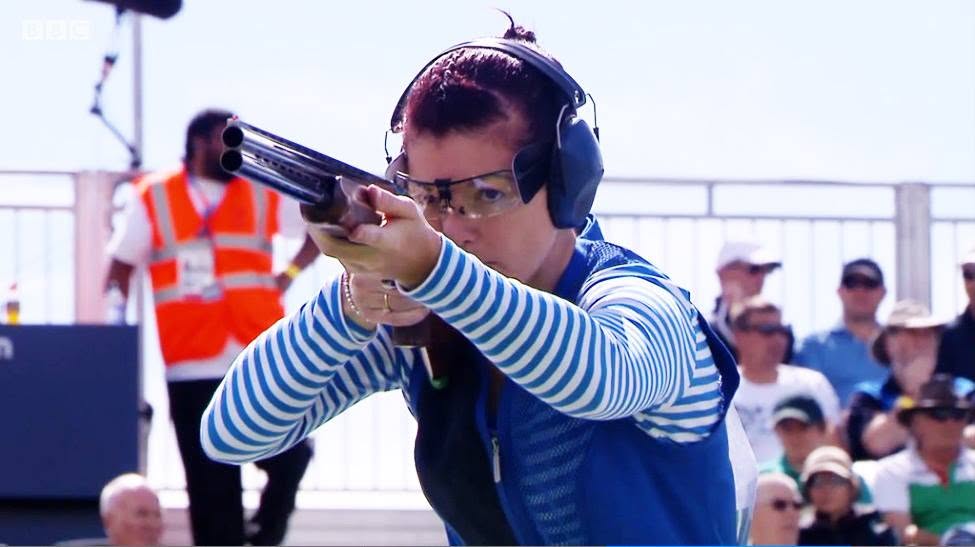
I’ve had quite a few key moments in my career, but the most precious was competing at the Commonwealth Games in Australia in 2018.
That was beyond words, the icing on the cake for everything I’d worked for. Just achieving the score needed to qualify and earning my place was incredible. Along the way, I was shooting Olympic Trap for Team GB, improving year after year and setting a few GB records as well.
But the moment I’m most proud of was standing there, representing Scotland at the Commonwealth Games in Australia.
Describe a challenge, setback, or disappointment in the sport that tested you, and what you learned from overcoming it.
Prior to the Commonwealth Games in Australia, I had started my Olympic Trap career four or five years earlier. Obviously, the Commonwealth Games only come around every four years, and in 2014 they were being held in Glasgow.
I was told from the beginning that my target should be Australia and that I wouldn’t make Glasgow. Nobody tells me I won’t achieve something, so I absolutely fought tooth and nail to make that team, despite having relatively little experience and training in Olympic Trap at the time.
In the end, I missed out by one-third of a clay average. That was it. One-third of a clay.
Even now, it still pulls at my heart a little bit when I talk about it. We appealed the decision, but the appeal was declined and I wasn’t selected.
Sport can batter you right down to the bottom, and it takes a strong person to claw their way back. When you get knocked down like that, you want to prove everybody wrong.
I remember saying to myself, “I won’t be in this position next time.”
When the next Commonwealth Games cycle came around and the qualification scores were announced, I had already achieved them within the first month.
What doesn’t kill you really does make you stronger, eh?
What has played the biggest role in your success that people may not know from the outside?
My equipment.
I’m absolutely confident in the training and preparation I’ve put in, but my equipment has played a huge role as well. I’ve been sponsored by Lyalvale Express for many years, and the 24g competition shell I used at the time was phenomenal. It was the Excel cartridge, and I absolutely loved it and now I shoot the Supreme Comp and love that just as much.
I also shoot a Beretta DT11, and that combination still works perfectly for me.
Of course, there are the countless hours of training, the travel, and all the work that goes into competing at a high level, but having equipment you can trust completely makes a massive difference. If your equipment isn’t up to the job, then you’re only ever going to be as good as your equipment lets you be.
Who has had the biggest influence on your development in the sport, and what impact have they had on your journey?
There have been a couple of people.
My dad, obviously, got me started and taught me everything from a young age with gun handling, safety, how to hit a clay, how to build confidence, and how not to let other people knock you down.
But by far the person who has had the biggest influence on my sporting career is my coach, Marco Micheli from Italy.
Marco was an Olympic Trap coach and remains a very dear friend. That man saw greatness in me before I saw it in myself. He encouraged me, pushed me, and supported me, all with genuine care.
He was the complete package. He was part coach, part sports psychologist, and somebody who understood exactly how I learned. By watching me shoot, he realised I was a visual learner. More than once he would pick up my gun and say, “No, Sharon, like this.”
Even today, he remains the biggest influence on my journey, my confidence, and the way I think about the sport.
That man will always have a place in my heart.
What is one moment in your shooting career that changed the way you think about success?
I had to think about this one because, for a long time, success was always about winning, podiums, medals, trophies.
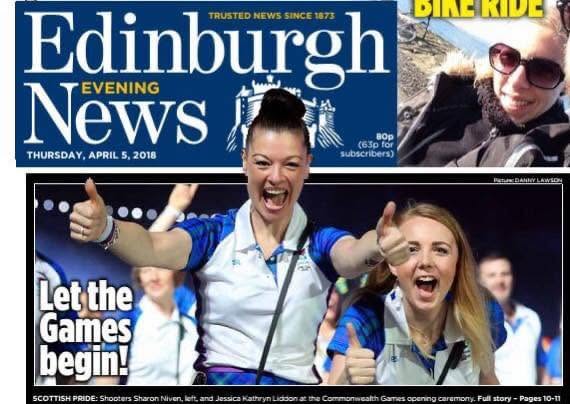
But the moment that changed my perspective was actually the opening ceremony at the Commonwealth Games in Australia.
Scotland led the athletes out because we had hosted the previous Commonwealth Games in Glasgow, and I happened to be right at the front. Suddenly I was all over the Edinburgh Evening News. People were sending me newspaper cuttings and photos.
I remember looking around and thinking, “I’ve made it. I’m here. I’m in the arena. I’m part of this.”
I wasn’t even competing at that exact moment, but it was the realisation that I’d achieved the goal I’d been chasing for years. Success wasn’t a medal int this case, it was simply making it there.
What is the next big thing you want to achieve?
That’s a tough question because my goals have changed a little bit over the years.
These days, I focus on smaller goals. I want to keep improving my personal bests and keep chipping away at them. I’d like to win more Scottish titles too.
I think my record is five Scottish titles in one year across five different disciplines. Maybe I can make that six?
It’s really about continuing to improve. If my personal bests keep getting better and better, then hopefully the wins will follow.

What misconception do people have about what it takes to compete at the highest levels?
I think a lot of people believe you can just turn up on a Saturday or Sunday and win.
It takes devotion. It takes time. It takes money. It takes effort. It takes your soul.
When I was training for the Commonwealth Games, the Olympic Trap team, and Team GB, I was training most days. I was firing thousands of cartridges, travelling constantly and competing all over the world.
I don’t think people fully realise the level of dedication required.
Looking back at everything you’ve achieved so far, what advice would you give to someone hoping to follow a similar path?
I tend to give the most advice to women who are just starting out in the sport.
I’ll never forget one lady who was shooting a registered sporting competition in Scotland. She was in a squad with a group of men and asked me, “How do you stay so calm and collected when you’re shooting?”
I told her it takes time, but most people aren’t wishing you ill, they actually want you to hit the targets.
The truth is, if you’re in a squad full of men, they’re not really focused on what you’re doing. They’re focused on their own targets and their own performance.
So concentrate on your shooting. Don’t worry about what anybody else thinks. Surround yourself with lovely, like-minded people and just avoid the rest.
If people only remembered one thing about your journey, what would you want it to be?
Dedication.
I think anyone who knows me would recognise the dedication I’ve put into this sport.
I’ve always believed that when I’m shooting, I should look composed. I never want people to see when I’m frustrated. I keep those emotions internal and I always smile, so nobody knows what I’m thinking.
But behind that smile has always been dedication. That’s what got me where I am, and that’s what I’d want people to remember.


